Saturday, 23 March 2013

Wild Hut 19

Location:
Dawsholm Park, Glasgow


Some weeks previously I had arranged to collaborate with a Glasgow-based design consultancy called Giraffe Architecture. Raymond from Giraffe shares my passion for sustainable design and is also quite partial to an outdoor-adventure on occasion which was more than handy. After various emails we had decided to build something that would really test our design skills and explore a more ‘engineered’ solution. So in order to push ourselves we decided to build a mathematically complex geodesic dome…from wobbly twigs.


Having in the past made various shelters that were either too narrow or too short, I was worried that this more precise geometric puzzle would be impossible to achieve on a cold, dark evening with some rickety branches. It didn’t help that some of the worst snow storms this year had hit Glasgow on the very day of the build. It doesn’t surprise me.


Travelling through the west end of Glasgow we arrived at the gates of Dawsholm Waste Transfer and Recycling Facility (or ‘the dump’ for short) in the early evening. The recycling plant has a surreal high-rise metal shed on the fringe of a small woodland park. This hilltop forest offers great views south over Glasgow’s west-end but is fairly exposed to the bitter east-wind and blustery snow showers which now fell.


The Build:
We gathered some sticks and walked along the long approach path leading to the woods. Dog-walkers were out in force utilising what was left of the diminishing daylight. From a distance we may have looked like park rangers clearing up the fallen branches from the path. This was hopeful at best. It was more likely they noticed the serious conviction written across our faces suggesting that we were working towards something bigger, more epic, but ultimately less useful than path-clearing. We walked past with our heads down, avoiding awkward questions and eye contact.


Tall trees had been knocked down by the wind in an elemental game of woodland dominos. Tipped trunks were precariously resting against adjacent trees, interlocked at high level. Many trees lay motionless on the forest floor, revealing a tiny pond below their upturned roods. We stashed our rucksacks deep in the branches of a fallen conifer tree and proceeded to find yet more sticks.


Eventually, we had gathered enough sticks for the main pentagonal components and decided to take a quick break for a cold dinner. Ray lifted his sandwich to find a mouse had nibbled a hole in the corner of the packet. Slightly concerned I hung our main food bag from a branch but was ultimately pleased to find these tiny creatures harbouring in the security of this fallen forest giant.

We got back to work arranging the pentagons which would form the basis for the hut. We required 5 large identical pentagons for this build. The pentagons were made from an inner and outer frame, inside which we trapped some fir branches from the adjacent fallen tree. They took around 45 mins each to assemble and we had the feeling that this adventure might be a late one.


I nipped back over to the food bag when a little golden mouse (possibly a wood or harvest mouse) sprung out the bag and disappeared along the branches. I almost jumped out of my freezing skin and was of the opinion I could probably outrun Raymond if the mouse decided to attack. It was actually great to see a little woodland creature so close-up, right in the heart of the city. They are also slightly cuter than the usual fat rats I encounter on the pavements outside shops.


A fox danced through the woods like a drugged gypsy, darting in various directions as the snowfall became more concentrated. It didn’t stay for long and headed towards the recycling centre for supper, or indeed to recycle. We completed the 5 pentagon sandwiches and had them arranged upright by midnight. It was freezing cold so we could never stop for very long without our fingers becoming increasingly numb.


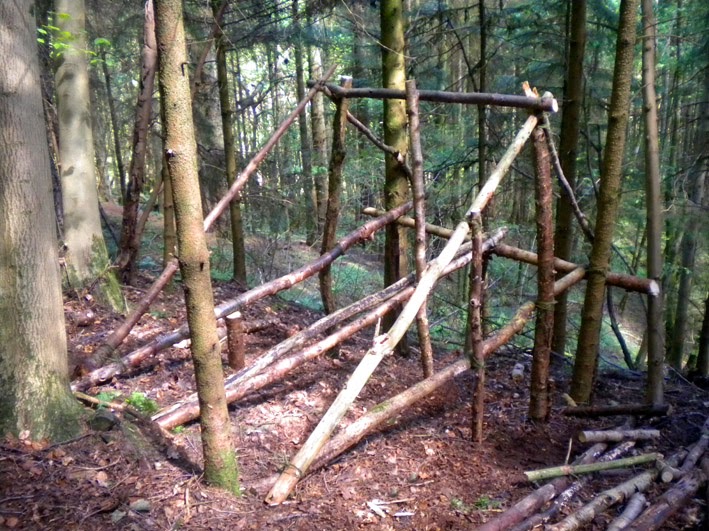
A couple of hours later we had arranged the roof and tiled it with the conifer branches from the adjacent deadwood tree. The hut looked surprisingly like a geodesic dome. I was surprised at how neat and structurally capable the form became. The rigid dome flexed and compressed to hold each of its components in place. The snowfall now seemed fairly heavy and I was sure that the hut would soon resemble an igloo rather than a finely panelised dome.


Roughing it:
We passed our gear through the small triangular door and rolled out our sleeping mats. Things weren’t much warmer in our sleeping bags as temperatures on the hill plummeted to around -7. Not ideal, although I learnt a good trick that by placing my hands deep into my pockets I was able to sleep without shivering. I wrapped a scarf around my face as tiny flakes of snow drifted through similarly tiny gaps in the structure. The hut became a great wind-break and we were more than pleased with this minor sheltering victory.

We chatted until late and fell asleep to the sounds of agitated trees moaning in the wind with old limbs creaking. A dog barking right outside the hut signalled morning and was a great natural alarm (reminiscent of clockwork, much like their toilet habits). We packed quickly as the morning air was much colder than the previous night, partnered by a fierce wind.


We skipped breakfast and made our way through the arterial maze of forest trails until we aligned once again with the main dump access road. The snow was still falling heavily and after a short commute I was back home and beginning to warm up slightly.

I decided to eat the croissant I had bought for our breakfast, but on further inspection the bag was chewed open and the croissant was hollowed out by that stealthy little mouse earlier. It’s lucky the rodent had retired as it may have well found itself on the menu after munching our breakfast!

Saturday, 16 March 2013

Wild Hut 18

Location:
Kinnoull Hill, Perth


Whilst relaxing in front of the TV one evening I received a random text from a friend which read: “Al Humphreys is around Crieff on the 14th and is looking for a micro-adventure. If you’re about you should contact him through his website and build a wild hut with him! He’d love it”. I laughed off this crazy notion for a few minutes until it quickly grew substance and formed details in my mind. Alastair Humphreys is an adventurer I’ve followed for some time who has completed many inspirational expeditions across the globe.


I thought it would be a bit like asking David Attenborough to come round to your house and make a documentary about your cat, it would be unlikely at best. I eventually decided to bite the bullet and contact Al - I could only embarrass myself I thought, and I was well used to that so where’s the harm!?’ I dropped him a quick email, confirmed details…and within hours it was strangely set in my diary.


Now – on a separate tangent, on the other side of the world, the famous Scottish cyclist and broadcaster Mark Beaumont was embarking on a brave ascent of Patagonia’s highest peak, Cerro San Valentin. Mark is a local lad, and was the obvious first choice for any micro-adventure in Perthshire. He initially had to decline due to his expedition commitments, but treacherous conditions and injury saw them return home one week early from the mountain. Mark was now keen to experience this strange den-building challenge and confirmed his attendance during the long-haul flights back from the Santiago.

To help record the event, I also enlisted my friend Richard Patterson (www.360pix.co.uk) who kindly offered to lend his photographic and log-chopping expertise.


The Kinnoull Hill in Perth is characterised by a dominating cliff-top wood and historic tower high above the bustling little city. It offers panoramic views south and east across the winding River Tay and westwards along the complicated concrete approach roads to Perth. Looking down from the edge you can often see great bursts of black crows exploding outwards from the rock face and bouncing effortlessly around in the passing updrafts.
The folly tower dates from 1892 and was built as a romantic gesture by Lord Grey of Kinfauns. Where most people buy flowers or chocolates, Grey went slightly over-board and attempted to recreate the castles-strewn landscape of Rhineland Germany!


It has also been claimed that William Wallace on occasion used the cliffs below Kinnoull Hill as a refuge when pursuit became too close for comfort. No doubt the so-called Dragon’s Hole, which was a substantial cave high up among the rocks, would have been one of the places to which he could retreat. Scottish folklore also hints at the cave being home to a dragon, although I believe more likely an angry badger.


More recently 14 woodland creature carvings have appeared throughout the forest by the sculptor Pete Bowsher. Unfortunately, the cliff top summit also has a sinister reputation as a suicide hotspot. In 2002, a 31-year-old mother-of-two, pushed her two infant children off the hill's summit while they were strapped in their pushchair, before throwing herself off. It’s a strange and dangerous place with a rich mix of history and dramatic views.

The Build:
We met Al following his talk at the outdoor learning conference in Crieff and had soon found a location for our shelter in the shadow of the old cliff-top folly. We had planned to build a simple A-frame shelter which contained 4 bunks and had a roof made from 4 triangular panels. We dispersed into the surrounding woods to source some large deadwood logs for the primary timber frame. Mark had planned to join us later that day as he had only just returned from his Chile expedition the evening prior.


We created some small A-frames which would support 2 large ridge-poles. We then strung the sleeping platforms to the frame and the basic structure was almost complete. Mark arrived in great time after cycling from his home 12 miles away. The heavy work was about to begin, as was the biting wind and fading light. Richard began work on the fire whilst Mark and Al completed the slats on the sleeping platforms. I began to construct a triangular roofing panel which would hopefully trap forest debris between two timber grids like a giant vegetarian toasty.


The most important part of the build was soon upon us – sausages! We ate dinner around the fire and resumed work on the roofing panels. The panels were fairly heavy and took some effort to cajole into place. By 11pm we had positioned all four of the roofing panels and decided to spend some time embellishing the bumpy sleeping platforms. We gathered armfuls of dry grass and spread it evenly across the 4 bunks which now looked surprisingly warm and comfortable.


Roughing it:
In hindsight, if we had spent 5 extra minutes arranging the initial timber posts we could have made the bunks slightly wider and indeed slightly longer which would have been a great help at this late stage. Instead we spent quite some time wriggling into our bunks and squeezing our feet deep into the diminishing corners of the hut.


If there was one thing I knew for definite about Mark Beaumont – is that I was never going to win the battle for feet space with his cycle-strong legs. The whistling wind picked up which soon complimented our chorus of synchronised snoring.


Far below us the cars moved like a river of red light towards Perth, turning yellow on whirlpool roundabouts. Dawn light soon filled the hut as the team woke to a cold bright morning. To the east the River Tay appeared milky-white with reflected sun light en-route to the sea. We gathered our gear and wandered back through the woods slightly tired but refreshed.


It was a pleasure to spend some time with people who are essentially challenging the boundaries and pushing the limits of human capabilities. The only thing I was challenging was the patience of the other commuters on the train home as I filled the carriage with the smell of damp earth and smoky campfires.


Click below to view a 360 Virtual Tour - by 360PIX


Read Mark Beaumonts Blog:

Saturday, 16 February 2013

Wild Hut 17

Location:
Edmiston Drive, Ibrox, Glasgow


Some colleagues showed a mild interest in building an ‘urban hut’ in Glasgow and with some minor preparation we were soon on the subway after work - bound for Glasgow’s south-side. These colleagues, Ewan Proctor Mason & Gordon Anderson are both season-ticket holders at the infamous Rangers Football Club. They were both aware of a small tract of redundant land to the west of the football stadium which could potentially harbour enough materials for a wild night out.


This part of Glasgow has a very unsavoury reputation, not only for match-day hooliganism but also for real-life murders. There is a noticeable breakdown in the urban fabric here with derelict buildings, storage units and high-rise tower blocks. One of Scotland’s most infamous murderers; Christopher Hutcheson, had once lived in a flat nearby and was thought to have tortured and killed some drug addicts for not paying their bills. He apparently garrotted one of them, chopped up the body and buried them in the back court. This psychopath also attacked people in the courtroom when standing trial. At least he was consistent.


It was with this sinister backdrop that we crossed the stadium overflow carpark and entered a tiny patch of dense woodland. A new railway yard had been extended recently which decimated 80% of this forgotten wild space. The last remaining thicket was situated at a lower level beneath the street and was bound by 2 redundant railway lines to the east and west. One of the old tracks was completely flooded and looked like a deep soupy canal with a fringe of green reeds. The other, to our dismay, contained 2 silhouetted figures spray-painting on the tunnel wall.

 
Much to the displeasure of Ewan and Gordon, we almost universally decided to stand our ground in the hope that they would eventually move off. Without much consultation, I nipped down the embankment towards the group, shown my torch at the pair and started gathering some of the branches which lay strewn on the wet forest carpet. I made sure I was overtly noisy and they soon got spooked and climbed up to the road bridge which overlooked the forest. From their perspective, they were suddenly blind-sided by strange cutting noises and flashing lights.


They tried to provoke a reaction from us by throwing something down then shouting and whistling. They couldn’t figure out what they were dealing with as we stayed quiet and were spread out through the forest. An evening of bushcraft didn’t fit within their frame of reference and so they were obviously uneasy and well-spooked with the situation. After a short time, they mounted their bikes and shouted down – “whit yah dain cuttin aw that wood ya beasts?...ya pure beasts!”  This was the last we heard from them as they sped off westwards towards Drumoyne. 


The Build:
Gordon had conceived the hut design to incorporate 3 sleeping platforms beneath a faceted roof and triangular walls. These all tapered back to a single point meaning that this particular concept was incredibly light on materials. I adapted the entrance for ease of access and built a computerised 3D model. It was just the trick for an evenings build!


For such a tiny patch of forest we were not short of building materials. We gathered enough timber for the whole structure in a very short time and piled it on what looked like an access ramp to forgotten railway platforms. There was a strange fenced-off section of dried plants which looked at first glance like the alien invader - Japanese Knotweed.
 
 
Suddenly strange whistling rang out from around the forest perimeter, covering any possible exit routes. 2 or 3 people where whistling to each other from the bridge to the north and carpark to our east. We watched the situation quietly, somehow feeling that we were being surrounded by a group of youths. As quickly as this threat built-up in our minds it dissolved back into the surrounding city streets and the forest returned to quiet.


We quickly pieced together the structural frame and laddered the walls and roof with twigs, ready to hang the outer skin.


We had noticed that the flooded railway tunnel had a healthy fringe of reeds which we could bale together for roofing tiles. We grabbed some food and completed the outer skin by 2am.


Roughing it:
Due to restricted internal space, we entered the bunks one at a time – awkwardly spreading our weight across these springy twig platforms. Much to my amusement Gordon’s bunk was around 1 foot too short. His feet had to rest on a higher beam in the back corner of the hut. He seemed mildly comfortable although was unable to move all night from this single position. We soon forgot the night’s earlier disruptions and fell asleep as the forest returned to a calm silence.


After a reasonable nights sleep, we woke at first light and packed our gear. Although the weather was reasonable through the night, the hut would have provided some decent shelter and indeed kept us high and dry off the wet forest leaf litter. We had found one of the cities many ‘green lungs’, a wilderness island surrounded by urban infrastructure. We were satisfied with what we had managed to achieve in such a tiny oasis and had successfully scared off the sinister locals. We left the security of the forest gully and re-emerged on the busy roadside looking like cheerful tramps.